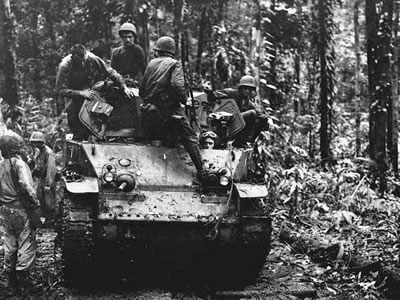
When the M3 light tank series was being produced, America needed radial engines to power aircraft. There was a concern that there would not be enough radial engines for all the airplanes that were being built, so the US decided to try to find other types of engines to power tanks. The M5 light tank …
Author Archives: M Malory
M3 Light Tank
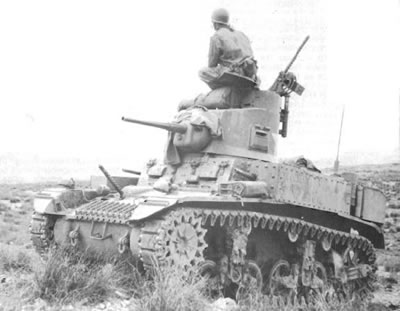
The M3 light tank was designed by the United States in the spring of 1940 and given to Great Britain as part of the lend-lease program. The British army officially designated the tank the Stuart; in Britain, the M3 was unofficially known as the Honey. The design of the M3 light tank was based on …
M4 Sherman Medium Tank
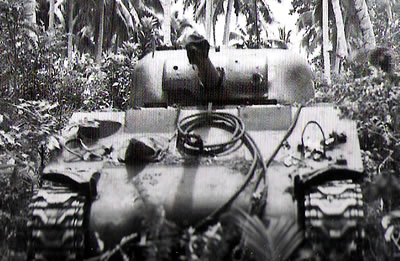
During World War II, the Allies used the M4 Sherman medium tank more than any other tank. The US built more than 49,000 Sherman tanks during World War II. This amounted to more than half of America’s tank production, and to the combined output of Germany and Great Britain. When production of the M3 Medium …
M3 General Lee/General Grant Medium Tank
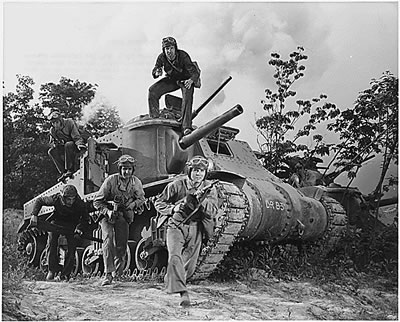
The standard version of the M3 medium tank was known as the General Lee by the British. When the British purchased the General Lee from the United States, under the Lend-Lease program, the British Army Service modified the design of the General Lee and called their modified version of the tank the General Grant. (General …
M2 Light Tank Series
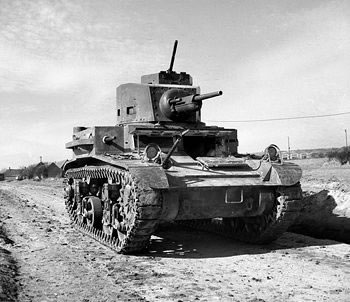
America had four main types of light armored fighting vehicles (AFVs) just before World War II began in Europe. These were Combat Cars M1 and M2, which were used by the cavalry, and Light Tanks M2A2 and M2A3, which were provided to the infantry. The design of all four of these vehicles was derived from …
M1 and M2 Combat Cars
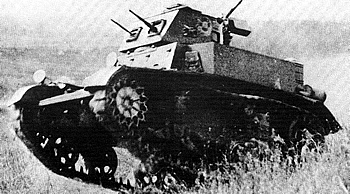
By the time World War II began in Europe, the United States had four kinds of light Armored Fighting Vehicles (AFVs). Two of these, Light Tanks M2A2 and M2A3, were used by the infantry, while the other two were used by the cavalry. The cavalry’s light AFVs were known as the M1 and M2 Combat …
Mark VIII Heavy Tank
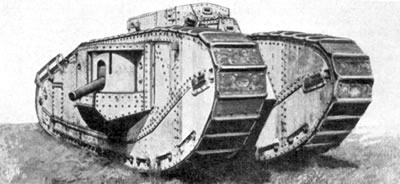
The production of the Mark VIII heavy tank, also known as the International, was supposed to have been a joint venture between Britain and the United States. Together, the two countries planned to build 4,450 Mark VIIIs as well as 2,000 Mark Xs. The design of the Mark X was never finished. Of all the …
Mark VI Light Tank
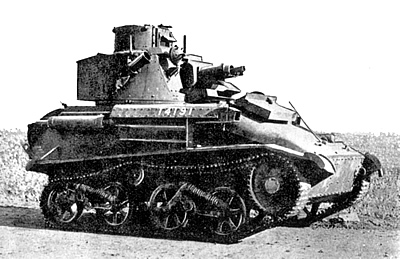
The Mark VI light tank resembled the Mark V light tank. However, the Mark VI’s turret was redesigned to fit a radio. Production of the Mark VI Light Tank series began in 1936. When World War II began, one thousand of these tanks were in service The Mark VI formed a large part of the …
Mark V Heavy Tank
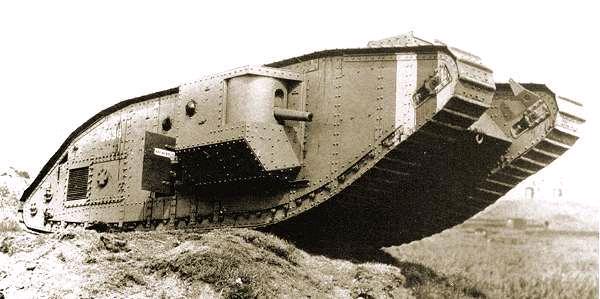
The Mark V Heavy Tank was the first of the British heavy tanks to require only one driver. This was because it had a new four-speed epicyclic gearbox, which was designed by W.G. Wilson. Other improvements included better ventilation and improved visibility for the crew. A new 150hp Ricardo engine powered the Mark V. While …
Mark IV Heavy Tank
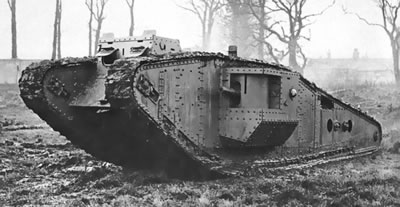
The Mark IV heavy tank was designed in October 1916 and produced between March and April 1917. {avsplayer videoid=3 playerid=1} The first time the Mark IV saw action was at the Battle of Messines Ridge on June 7, 1917. However, the Mark IV heavy tank is most famous for its performance at the Battle of …
Mark V Light Tank
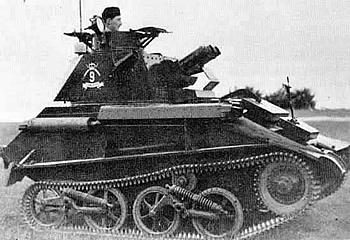
The Mark V light tank was the first light tank to have a turret that accommodated two men. This meant that the tank carried three crewmembers, while earlier British light tanks had only two crewmembers. In order for there to be enough room for the larger turret, as well as a turret ball race, the …
Mark IV Light Tank
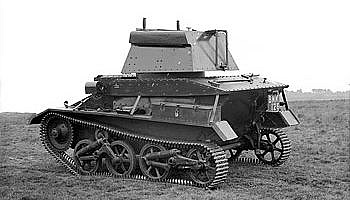
Britain’s Mark IV light tank, which was developed by Vickers in the 1930s, was the first light tank in which the armored hull formed the chassis. Automotive parts were bolted onto the hull. Its design was based on that of experimental “Indian Pattern” armored vehicles by Vickers. The Mark IV had a longer hull than …